Showing posts with label Cayman Islands coins. Show all posts

Cayman Islands Gold Coin 100 Dollars gold coin of 1977, Queens of England.

Cayman Islands 50 dollars Proof gold coin
Cayman Islands Queens of England 50 dollars Proof gold coins
Cayman Islands Gold Coins - $100 Dollars, Queens of England Gold Proof Coin, minted in 1977.
coin weighs .3646 ounces of pure gold.

Features cameo portraits of Queen Mary I & II, Queen Elizabeth I, Queen Anne, and Queen Victoria. Scarce, only 8,053 minted.

Cayman Islands Gold Coins 50 Dollars Gold Coin of 1977, Queen Victoria "Queens of England".

Cayman Islands 50 dollars Proof gold coin
Cayman Islands 50 dollars Proof gold coin QUEEN VICTORIA
Cayman Islands Gold Coins - $50 Dollars Gold Coin of 1977, Queen Victoria "Queens of England".
coin weighs .1823 ounces of pure gold.


Queen Victoria (Alexandrina Victoria; 24 May 1819 – 22 January 1901) was the monarch of the United Kingdom of Great Britain and Ireland from 20 June 1837 until her death. From 1 May 1876, she used the additional title of Empress of India.
Victoria was the daughter of Prince Edward, Duke of Kent and Strathearn, the fourth son of King George III. Both the Duke of Kent and King George III died in 1820, and Victoria was raised under close supervision by her German-born mother Princess Victoria of Saxe-Coburg-Saalfeld. She inherited the throne at the age of 18, after her father's three elder brothers had all died, leaving no legitimate, surviving children. The United Kingdom was already an established constitutional monarchy, in which the sovereign held relatively little direct political power. Privately, Victoria attempted to influence government policy and ministerial appointments. Publicly, she became a national icon, and was identified with strict standards of personal morality.
Victoria married her first cousin, Prince Albert of Saxe-Coburg and Gotha, in 1840. Their nine children married into royal and noble families across the continent, tying them together and earning her the nickname "the grandmother of Europe". After Albert's death in 1861, Victoria plunged into deep mourning and avoided public appearances. As a result of her seclusion, republicanism temporarily gained strength, but in the latter half of her reign, her popularity recovered. Her Golden and Diamond Jubilees were times of public celebration.
Her reign of 63 years and seven months, which is longer than that of any other British monarch and the longest of any female monarch in history, is known as the Victorian era. It was a period of industrial, cultural, political, scientific, and military change within the United Kingdom, and was marked by a great expansion of the British Empire. She was the last British monarch of the House of Hanover. Her son and successor, Edward VII, belonged to the House of Saxe-Coburg and Gotha, the line of his father.

Cayman Islands Gold Coins 50 Dollars Gold Coin of 1977, Queen Mary II "Queens of England".

Cayman Islands 50 dollars Proof gold coin
Cayman Islands 50 dollars Proof gold coins QUEEN MARY II
Cayman Islands Gold Coins - $50 Dollars Gold Coin of 1977, Queen Mary II "- Queens of England".
coin weighs .1823 ounces of pure gold.


Queen Mary II of England (30 April 1662 – 28 December 1694) was joint Sovereign of England, Scotland, and Ireland with her husband (who was also her first cousin), William III and II, from 1689 until her death. William and Mary, both Protestants, became king and queen regnant, respectively, following the Glorious Revolution, which resulted in the deposition of her Roman Catholic father, James II and VII. William became sole ruler upon her death in 1694. Popular histories usually refer to their joint reign as that of "William and Mary".
Mary wielded less power than William when he was in England, ceding most of her authority to him, though he heavily relied on her. She did, however, act alone when William was engaged in military campaigns abroad, proving herself to be a powerful, firm, and effective ruler.

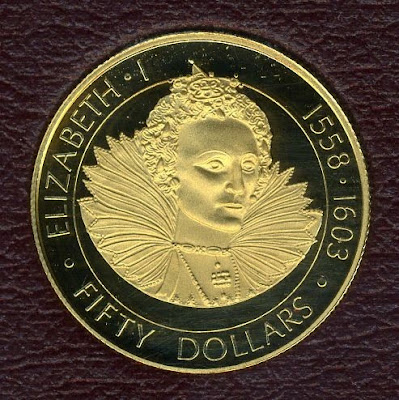
Cayman Islands Gold Coins 50 Dollars Gold Coin of 1977, Queen Elizabeth I "Queens of England".

Cayman Islands 50 dollars Proof gold coin
Cayman Islands 50 dollars Proof gold coins ELIZABETH I
Cayman Islands Gold Coins - $50 Dollars Gold Coin of 1977, Queen Elizabeth I - "Queens of England".
coin weighs .1823 ounces of pure gold.


Queen Elizabeth I of England (7 September 1533 – 24 March 1603) was queen regnant of England and Ireland from 17 November 1558 until her death. Sometimes called "The Virgin Queen", "Gloriana" or "Good Queen Bess", Elizabeth was the fifth and last monarch of the Tudor dynasty. The daughter of Henry VIII, she was born into the royal succession, but her mother, Anne Boleyn, was executed two and a half years after her birth, with Anne's marriage to Henry VIII being annulled, and Elizabeth hence declared illegitimate. Her half-brother, Edward VI, ruled as king until his death in 1553, whereupon he bequeathed the crown to Lady Jane Grey, cutting his two half-sisters, Elizabeth and the Roman Catholic Mary, out of the succession in spite of statute law to the contrary. His will was set aside, Mary became queen, and Lady Jane Grey was executed. In 1558, Elizabeth succeeded her half-sister, during whose reign she had been imprisoned for nearly a year on suspicion of supporting Protestant rebels.
Elizabeth set out to rule by good counsel, and she depended heavily on a group of trusted advisers led by William Cecil, Baron Burghley. One of her first moves as queen was the establishment of an English Protestant church, of which she became the Supreme Governor. This Elizabethan Religious Settlement later evolved into today's Church of England. It was expected that Elizabeth would marry and produce an heir so as to continue the Tudor line. She never did, however, despite numerous courtships. As she grew older, Elizabeth became famous for her virginity, and a cult grew up around her which was celebrated in the portraits, pageants, and literature of the day.
In government, Elizabeth was more moderate than her father and half-siblings had been.  One of her mottoes was "video et taceo" ("I see, and say nothing"). In religion she was relatively tolerant, avoiding systematic persecution. After 1570, when the pope declared her illegitimate and released her subjects from obedience to her, several conspiracies threatened her life. All plots were defeated, however, with the help of her ministers' secret service. Elizabeth was cautious in foreign affairs, moving between the major powers of France and Spain. She only half-heartedly supported a number of ineffective, poorly resourced military campaigns in the Netherlands, France, and Ireland. In the mid-1580s, war with Spain could no longer be avoided, and when Spain finally decided to attempt to conquer England in 1588, the failure of the Spanish Armada associated her with one of the greatest military victories in English history.
Elizabeth's reign is known as the Elizabethan era, famous above all for the flourishing of English drama, led by playwrights such as William Shakespeare and Christopher Marlowe, and for the seafaring prowess of English adventurers such as Francis Drake. Some historians are more reserved in their assessment. They depict Elizabeth as a short-tempered, sometimes indecisive ruler, who enjoyed more than her share of luck. Towards the end of her reign, a series of economic and military problems weakened her popularity. Elizabeth is acknowledged as a charismatic performer and a dogged survivor, in an age when government was ramshackle and limited and when monarchs in neighbouring countries faced internal problems that jeopardised their thrones. Such was the case with Elizabeth's rival, Mary, Queen of Scots, whom she imprisoned in 1568 and eventually had executed in 1587. After the short reigns of Elizabeth's half-siblings, her 44 years on the throne provided welcome stability for the kingdom and helped forge a sense of national identity.

Cayman Islands Coins 50 Dollars Gold Coin of 1977, Queen Mary I "Queens of England".

Cayman Islands 50 dollars Proof gold coin
Cayman Islands 50 dollars Proof gold coins Queens of England QUEEN MARY
Cayman Islands Coins - $50 Dollars Gold Coin of 1977, Queen Mary I "Queens of England".
coin weighs .1823 ounces of pure gold.


Mary I of England (18 February 1516 – 17 November 1558) was Queen of England and Ireland from July 1553 until her death. Her executions of Protestants caused her opponents to give her the sobriquet "Bloody Mary".
She was the only child of Henry VIII and his first wife Catherine of Aragon who survived to adulthood. Her younger half-brother, Edward VI, succeeded Henry in 1547. When Edward became mortally ill in 1553, he attempted to remove Mary from the line of succession because of religious differences. On his death their first cousin once removed, Lady Jane Grey, was initially proclaimed queen. Mary assembled a force in East Anglia and successfully deposed Jane, who was ultimately beheaded. In 1554, Mary married Philip of Spain, becoming queen consort of Habsburg Spain on his accession in 1556.
As the fourth crowned monarch of the Tudor dynasty, Mary is remembered for her restoration of Roman Catholicism after the short-lived Protestant reign of her half-brother. During her five-year reign, she had over 280 religious dissenters burned at the stake in the Marian persecutions. Her re-establishment of Roman Catholicism was reversed after her death in 1558 by her younger half-sister and successor, Elizabeth I.