Showing posts with label New Zealand Currency. Show all posts

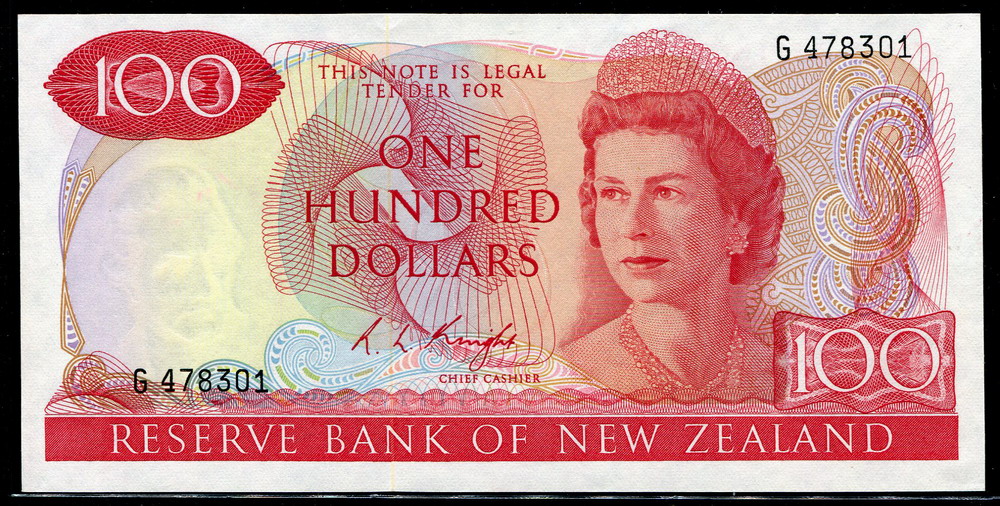
New Zealand banknotes 100 Dollars note, Queen Elizabeth II.

New Zealand currency 100 Dollars banknote Queen Elizabeth II
100 New Zealand Dollars
money New Zealand currency 100 Dollars
100 New Zealand Dollars banknote

New Zealand one hundred-dollar note


Reserve Bank of New Zealand 100 Dollars Banknote - Decimal Currency
New Zealand one hundred-dollar note, New Zealand banknotes, New Zealand paper money, New Zealand bank notes.
The New Zealand dollar NZD is the currency of New Zealand.

Obverse: Portrait of Her Majesty Queen Elizabeth II wearing Queen Alexandra's Kokoshnik tiara, King George's VI festoon necklace, and Queen Mary's floret earrings.
Various geometric patterns used to supply the necessary security and enhance the design. Value of note on top left and bottom right corners with the serial number opposite.
Reverse: Takahe (Porphyrio mantelli), a very rare flightless bird found in the Southwest of the South Island.
Mountain daisy or pekapeka (Celmisia gracilenta) is found in sub-alpine areas and has a white flower. It is a popular subject for outdoor sketches.

Window watermark panel containing portrait of Captain Cook.

New Zealand banknotes 5 Pounds banknote of 1934, Maori Chief.

New Zealand banknotes 5 Pounds Maori Chief Kiwi money pictures images
 New Zealand 5 Pounds banknote, Maori Chief - Māori King
World Currency New Zealand 5 Pounds banknote Milford Sound and Mitre Peak
New Zealand 5 Pounds bank note
Currency of New Zealand - 5 Pounds banknote of 1934, issued by the Reserve Bank of New Zealand.
New Zealand banknotes, New Zealand paper money, New Zealand bank notes, New Zealand pound.

Obverse: Portrait of Maori Chief with Tattooed Face and the Kiwi Bird.
Reverse: Milford Sound and Mitre Peak.
Printed by Thomas De La Rue & Company, Limited, London.

Maori Chief - Matutaera Tāwhiao (Tūkāroto Matutaera Pōtatau Te Wherowhero Tāwhiao; died 26 August 1894) was leader of the Waikato tribes, the second Māori King and a religious visionary. He was a member of the Ngāti Mahuta iwi (tribe) of Waikato.

New Zealand banknotes 20 Dollars note, Queen Elizabeth II.

New Zealand money 20 Dollars Queen Elizabeth II
 20 New Zealand Dollars 
New Zealand currency 20 Dollars
 20 New Zealand Dollars banknote 

New Zealand twenty-dollar note


Reserve Bank of New Zealand 20 Dollars Banknote - Decimal Currency
New Zealand twenty-dollar note, New Zealand banknotes, New Zealand paper money, New Zealand bank notes.
The New Zealand dollar NZD is the currency of New Zealand.

Obverse: Portrait of Her Majesty Queen Elizabeth II wearing Queen Alexandra's Kokoshnik tiara, King George's VI festoon necklace, and Queen Mary's floret earrings.
Various geometric patterns used to supply the necessary security and enhance the design. Value of note on top left and bottom right corners with the serial number opposite.
Reverse: Wood Pigeon or kereru (Hemiphaga novaeseelandiae) is a large bird with greyish green feathers on its back and head, and a smart white vest.
Miro (Prumnopitys ferruginea), is a large tree with fleshy yellow berries that turn bright red.
Window watermark panel containing portrait of Captain Cook.

New Zealand banknotes 10 Dollars note, Queen Elizabeth II.

money New Zealand currency 10 Dollars Queen Elizabeth II
 10 New Zealand Dollars note Queen Elizabeth II 
New Zealand currency 10 Dollars banknote
 10 New Zealand Dollars banknote 

New Zealand ten-dollar note


Reserve Bank of New Zealand 10 Dollars Banknote - Decimal Currency
New Zealand ten-dollar note, New Zealand banknotes, New Zealand paper money, New Zealand bank notes.
The New Zealand dollar NZD is the currency of New Zealand.

Obverse: Portrait of Her Majesty Queen Elizabeth II wearing Queen Alexandra's Kokoshnik tiara, King George's VI festoon necklace, and Queen Mary's floret earrings.
Various geometric patterns used to supply the necessary security and enhance the design. Value of note on top left and bottom right corners with the serial number opposite.
Reverse: Kea (Nestor notabilis), a native parrot with beautiful plumage of olive green. The undersides of their wings are bright red.
Mountain lily (Ranunculus lyallii) is a member of the buttercup family with large waxy white flowers.

Window watermark panel containing portrait of Captain Cook.

The New Zealand Dollar (1967 - present)

In 1967, when the country decimalized its currency, the dollar replaced the New Zealand pound at a rate of 2 dollars = 1 pound. Like other dollar denominated currencies, the dollar sign "$" is used to express prices in New Zealand dollars, sometimes prices are written using NZ$ to distinguish it from other dollar currencies. The New Zealand dollar's ISO 4217 code is NZD. The value of the New Zealand dollar was initially pegged to the US dollar at a rate of US$1.39 = NZ$1. This rate changed on 21 November 1967 to US$1.12 = NZ$1 after the devaluation of the British pound, although the New Zealand dollar was devalued to a greater extent than the British pound sterling.
In 1971, the U.S.A. devalued its dollar relative to gold, leading New Zealand to peg its dollar at a value of US$1.216 with a 4.5% fluctuation range on 23 December (keeping the same gold value). From 9 July 1973 to 4 March 1985 the dollar's value was determined from a trade-weighted basket of currencies. Since 4 March 1985 the dollar's value has been determined by the financial markets, and has been in the range of about 0.39–0.74 United States dollars. The dollar's most recent minimum average daily value was 0.3922 U.S. dollars on 22 November 2000, and its most recent maximum was 0.7442 U.S. dollars on 17 March 2005.

New Zealand banknotes 5 Dollars note, Queen Elizabeth II.

money New Zealand currency 5 Dollars Queen Elizabeth II
 5 New Zealand Dollars note Queen Elizabeth II 
New Zealand currency 5 Dollars banknote
 5 New Zealand Dollars banknote 

New Zealand five-dollar note


Reserve Bank of New Zealand 5 Dollars Banknote - Decimal Currency
New Zealand five-dollar note, New Zealand banknotes, New Zealand paper money, New Zealand bank notes.
The New Zealand dollar NZD is the currency of New Zealand.

Obverse: Portrait of Her Majesty Queen Elizabeth II wearing Queen Alexandra's Kokoshnik tiara, King George's VI festoon necklace, and Queen Mary's floret earrings.
Various geometric patterns used to supply the necessary security and enhance the design. Value of note on top left and bottom right corners with the serial number opposite.
Reverse: Tui (Prosthermadera novaeseelandiae), a honey-eating bird with a characteristic white plumage at the throat and a beautiful bell-like song.
Kowhai (Sophora microphylla), a tree with large golden nectar-secreting blossoms.

Window watermark panel containing portrait of Captain Cook.

New Zealand Dollar Banknotes

In 1967, notes were introduced by the Reserve Bank of New Zealand in denominations of 1, 2, 5, 10, 20 and 100 dollars. 50 dollar notes were added in 1983, whilst 1 and 2 dollar notes were discontinued in 1991. The first two series of notes (1967-81 and 1981-92) differed only in the portrait of the Queen featured on the obverse. The reverses all depicted native birds and plants and remained unchanged through both series.
In 1992 A completely redesigned new series of banknotes was introduced by the Reserve Bank of New Zealand and except for the 20 dollars, the portrait of the Queen was dropped from all notes.
New Zealand banknotes, since 1999, have been printed on plastic polymer instead of conventional rag paper used for banknote production. There was a slight controversy, but this move was mostly met with curiosity by the public. Such polymer notes have many advantages, notably a photocopy can effortlessly be distinguished from the real thing by touch, and many people have been thankful that the notes go through a washing machine with no ill effects. The notes are also difficult to tear without the aid of a cutting tool, but will tear more easily than the paper notes if a tear is started. Initial versions of the polymer $5 note had issues with the ink wearing and aging prematurely, but this was rectified in later production runs. The Reserve Bank states that polymer banknotes last at least four times as long as the old conventional paper banknotes. The polymer banknotes also have vastly improved security features and are very difficult to counterfeit.
New Zealand banknotes 5 Pounds note, Captain James Cook.

New Zealand currency 5 Pounds banknote, Captain James Cook
New Zealand Wilson 5 Pound Note, Captain James Cook 
New Zealand currency Pounds banknotes
 New Zealand Fleming 5 Pounds banknote  
Currency of New Zealand - 5 Pounds banknote, issued by the Reserve Bank of New Zealand.
New Zealand banknotes, New Zealand paper money, New Zealand bank notes, New Zealand pound.

Obverse: An engraved portrait of Captain James Cook (7 November 1728 – 14 February 1779), British explorer, navigator, cartographer, and captain in the Royal Navy. Cook made detailed maps of Newfoundland prior to making three voyages to the Pacific Ocean, during which he achieved the first European contact with the eastern coastline of Australia and the Hawaiian Islands, and the first recorded circumnavigation of New Zealand.
Reverse: An engraving of Lake Pukaki and Mount Cook / Aoraki at centre. At left New Zealand Fantail or its Maori name, Pīwakawaka or Tīwakawaka - small insectivorous bird.
Printed by Thomas De La Rue & Company, Limited, London.

New Zealand pound

The pound was the currency of New Zealand from 1840 until 1967, when it was replaced by the New Zealand dollar.
Like the British pound, it was subdivided into 20 shillings each of 12 pence. As a result of the great depression of the early 1930s, the New Zealand agricultural export market to the UK was badly affected. The Australian banks, which controlled the New Zealand exchanges with London, decided to devalue the New Zealand pound in relation to sterling in the UK. By 1933, the New Zealand pound had fallen to a value of only 16 shillings sterling. In 1948 however, it was once again restored to its original sterling value. In 1967, New Zealand decimalised its currency, replacing the pound with the dollar at a rate of $2 = £1 (or $1 = 10s). In November of that year, the pound sterling devalued, and New Zealand used this as an opportunity to re-align its new dollar to parity with the Australian dollar.