|
| Banknotes of the East African shilling |
 |
| one hundred shillings or 5 pounds banknote |
World paper money - British
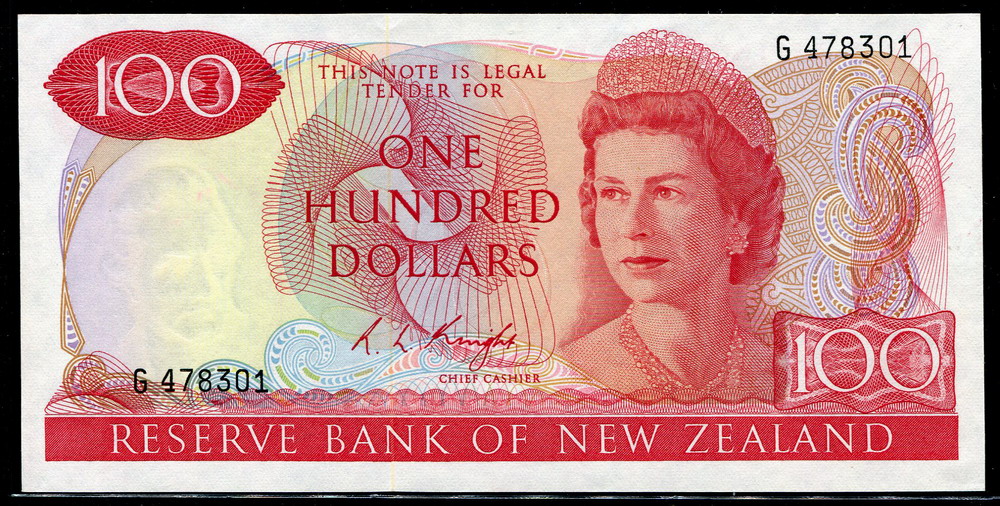
East Africa 100 Shillings or 5 Pound banknote of 1955, issued by the East African Currency Board.
Obverse: Portrait of
Queen Elizabeth II. Value in shillings written in English, Arabic, and Gujarati. Value in pounds written in English only.
Reverse: African Lion in front of mountain.
Printed by Thomas de la Rue, London.
The East African Currency Board.
The East African Currency Board was established in 1919 to issue and administer the currency circulating in British East Africa. The areas in which the Currency Board operated were Tanganyika, Zanzibar and Pemba, Kenya, Uganda and British Somaliland. Until the advent of the East African Currency Board, the Indian rupee had been the currency of these protectorates, colonies and mandates. The first issue of the East African Currency Board had been preceded by an issue of rupees under the authority of the Government of the East Africa Protectorate in 1905. (The Protectorate consisted of the area now constituting Kenya.) The East African Currency Board issued its first currency in 1920. The initial issue of a 1-rupee note, was followed by an issue of florin notes in the same year and in the following year the first shilling notes were issued.
The first note issue by the East African Currency Board was driven by a serious imperative. The bullion value of the silver rupees circulating in East Africa had become worth more than their face value. From less than two shillings per fine ounce in 1902, silver had risen to around seven shillings per fine ounce in 1919. This meant that the silver rupee was worth about 2.75 shillings, as opposed to its official value of approximately 1.33 shillings. In an effort to stabilize the currency, the East African Currency Board decided to redeem the silver rupees for 2.0 shillings each. The operation to redeem the silver rupees began in 1921, but at this time the price of silver began to drop, following the collapse of the post-war boom. Consequently, adventurers and speculators gathered silver rupees in Arabia and India, and exchanged them in East Africa at the profitable rate offered by the East African Currency Board. This activity, needless to say, increased the losses sustained by the Board due to the falling price of silver.
By the mid-1920s the Board had over £2.5 million in uncovered liabilities, with this figure growing to £3.2 million by the end of the great depression in 1932. Although the Governments of Kenya, Tanganyika and Uganda stood behind the Board, in order to prevent a suspension of payments, the position of the Board was tenuous. However, the position of the Board improved over the next decade with an increase in circulation, particularly during the war years of 1939-45. Although the Board made a profit over these years, the profit was not paid as a dividend, but was used to replace the losses previously incurred and, finally, to build a reserve fund. It was not until the 1950-51 financial year that the Board was able to pay its first dividend.
For many years Southern Arabia was governed from India as part of the empire of British India. In 1937 Aden became a colony and the administration for Aden (and for the remaining Southern Arabian protectorates) was moved from India to Aden. Until this time, it was sensible for Aden to use the Indian rupee as its official currency, but once it had obtained its own centre of government, the question of currency could be reviewed. With British Somaliland just across the Gulf of Aden, there was much to be recommended in adopting the East African Shilling. Added to this consideration was the fact that the commerce facilitated through the traditional trade routes, from Southern and Eastern Arabia to the coast of East Africa, would also benefit from a common currency. While it is not known when the move to adopt the East African Shilling was first mooted, there would have been hesitation for two reasons. Firstly, the Second World War must have retarded any initiatives from 1939 to 1945 and, secondly, there would have been little incentive for Aden to join a Board that had substantial debts. With the end of the war and the payment of the first dividends by the Board in 1951, there remained no obstacles and Aden chose to join the East African Currency Board. Represented on the Board, Aden took part in the deliberations of the Board and as a full member was entitled to receive a share in the profits of the Board.
The East African Shilling became the lawful money of the colony of Aden in 1951 and not only circulated in Aden, but also in the surrounding protectorates. While there was no consideration given to according the Shilling any legal status in the protectorates, it circulated there with confidence amongst
Maria Theresa Dollars and other silver coins. Such was the acceptance of the Shilling in the protectorates, that an agency of the East African Currency Board was established at Mukalla, the principal port of the Eastern protectorates. With considerable trade passing through Aden, it was not long before the Shilling was also being accepted in the Yemen and in the Persian Gulf. The wide distribution of the Shilling was in no way due to the authority of the East African Currency Board, but simply due to it being Aden's legal currency.
At the time Aden adopted the Shilling of the East African Currency Board, the bank note circulation of the Board consisted of six denominations: 1, 5, 10, 20, 100 and 10,000 shillings (nos. 27, 28, 29, 30, 31 & 32 in the Standard Catalog of World Paper Money). These notes, which carried the portrait of King George VI, were issued between 1938 and 1951. While there were only six denominations, the 5-, 10- and 20-shilling notes occur with varieties due to the need to print these notes in India during the war (nos. 28A, 29A & 30A in the Standard Catalog of World Paper Money). These notes have a different style of serial number and do not carry the printer's imprint of "Thomas De La Rue & Co Ltd London" that appeared on the other varieties of these notes. (Although there were six denominations in this series, it is understood that only the 5, 10, 20 and 100 shilling notes were issued in Aden.)
In 1953 the East African Currency Board issued a new series of notes due to the accession of Queen Elizabeth II to the throne of the United Kingdom. The notes, naturally enough, carry her portrait. However, with this series of notes there were only four denominations issued: 5, 10, 20 and 100 shillings (nos. 33, 34, 35 & 36 in the Standard Catalog of World Paper Money). These notes were of a different design to the previous issue, while maintaining a similar style. A lithographic print covers the note, which includes a colour band running vertically through the note. On top is printed an intaglio over-print. The paper has a patterned watermark covering the entire sheet on which the notes were printed. The pattern is a honey-comb with the letters "EACB" appearing in each compartment formed by the honey-comb.
In 1958 another issue of notes was made (nos. 37, 38, 39 & 40 in the Standard Catalog of World Paper Money), this time with a dramatic change in the style of design used on the notes. The notes are slightly smaller and each note has a different colour of intaglio ink, as well as different colours on the under-print. There is a larger vignette carrying the portrait of Queen Elizabeth, and the lines of the note appear cleaner and more modern. A single watermark of the head of a lion appears in the bottom centre of the notes. In 1961 the notes were slightly modified to carry seven signatures, as opposed to the four of the previous issue (nos. 41, 42, 43 & 44 in the Standard Catalog of World Paper Money).
By 1962 Aden was considering the introduction of its own currency. This move was being considered because of changes to the East African Currency Board and because of political changes in East Africa. From its inception, the East African Currency Board had been physically located in London and administered by Whitehall officials, although its principal office was located in Nairobi. In 1960 the East African Currency Board was transferred from London to East Africa. On relocating to East Africa a local Chairman was appointed and only one member of the old Board continued on the new Board—as a currency expert. Along with this change, other changes were being considered by member countries. British Somaliland had withdrawn from the Board in 1961 and with the impending independence of a number of member countries of the East African Currency Board, the real possibility arose of a central bank being created to take over the role of the East African Currency Board, or central banks being created in each country. Both options were seen to be disadvantageous to the Aden Government. Although largely removed from East Africa and its political and economic environment, being a member of the East African Currency Board meant that the economic and political problems of that region also affected Aden, although Aden remained politically and economically stable.
On the other hand, the East African Currency Board had been extremely successful during the period that Aden had been a member. From 1951 to 1960 the East African Currency Board had been a model of a colonial currency board and had been more successful in maintaining liquidity and avoiding capital depreciation than most currency boards. From 1952 to 1962 the East African Currency Board had paid dividends of more than £918,000 and had built substantial reserves, of which it was estimated in 1962 that Aden was due some £500,000 should it terminate its membership of the Board. Circulation in Aden had increased and in 1962 the agency at Mukalla was being considered for conversion to a full sub-centre of the Board.
Considering all arguments, it was decided by the Government of Aden that the colony would be better served by introducing its own currency board, which would not be subject to external influences to the degree that the East African Currency Board, or its successor, might be influenced. Consequently, the South Arabian Currency Board was established and plans were implemented to introduce the South Arabian Dinar.
While planning for the introduction of the Dinar was underway, the East African Currency Board decided to introduce a new series of notes. This series was introduced in October 1964 and was referred to as the "Lake Victoria" issue, because each note carried a common design on their front of a sailing vessel on Lake Victoria. The authorities in Aden were planning to introduce their own currency in early 1965 and did not want to have the complication of a new series of notes being introduced only months before their own issue. Consequently, a request was made to the East African Currency Board not to issue the new series in Aden, but to maintain the circulation of the old notes until Aden had introduced their own currency. This request was adhered to and any "Lake Victoria" notes that found their way to Aden by way of trade were repatriated to Nairobi.
During the period of conversion in Aden, following the introduction of the South Arabian Dinar on 1 April 1965, some £ EA 17 million were tendered by the public. This figure was much higher than the estimates that had been made during the deliberations leading up to the introduction of the dinar, indicating that Aden was responsible for a much larger proportion of East African Currency Board bank notes in circulation than it had previously been credited. Although, it later became apparent that much of the East African Currency Board Shillings that were tendered for exchange were coming from traders in the Yemen and the Persian Gulf.
The notes that were introduced by the South Arabian Currency Board in 1965 bore a great similarity to the issue of the East African Currency Board that was being replaced. Firstly, there were only four denominations in the initial issue of the South Arabian Currency Board: 5 dinars, 1 dinar, 500 fils and 250 fils. Each of these denominations was equal in value to the four denominations of the East African Currency Board, so that 5 dinars equaled 100 shillings, 1 dinar equalled 20 shillings, 500 fils equalled 10 shillings and 250 fils equalled 5 shillings. Secondly, the colours used for each note issued by the South Arabian Currency Board were exactly the same as those used for the notes issued by the East African Currency Board from 1958 to 1963. These measures ensured that the public of South Arabia would see a great similarity between the new notes and the notes of the East African Currency Board that were being replaced.
It is not known when the East African Currency Board Shilling ceased to be legal tender in Aden, but while the conversion process was largely completed by the end of August 1965, bank notes of the East Africa Currency Board were still being tendered for exchange at the end of the year.
Thus came to the end the issue of the notes of the East African Currency Board in the Arabian Peninsula. The East African Currency Board continued to issue notes for use in Africa for a number of years after Aden quit the Board. Undoubtedly the notes were accepted in trade around the Peninsula for a number of years after this, but they were no longer legal currency in any part of the Peninsula. In considering paper money that has been issued in the Arabian Peninsula, the notes of the East African Currency Board are often overlooked; but they hold a distinct place in the history of currency issued in the Peninsula.